Macos Server 5.6.3
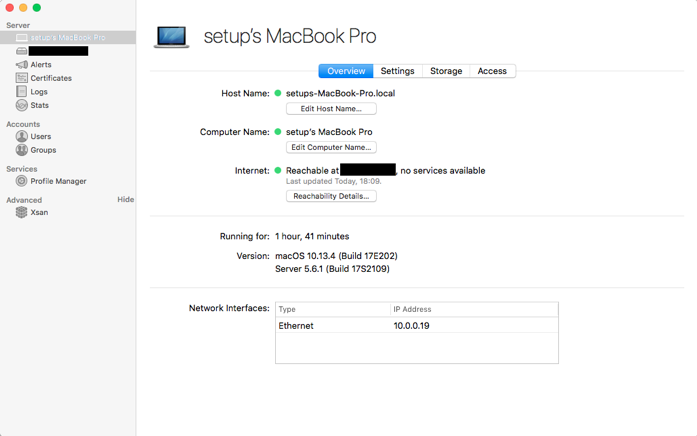
Mac OS Server 5.4 included all listed services. MacOS Server 5.6.3 and later appears to still include all listed services but many of them are now hidden on the main Server application administration window. As you can see, since the update on Mac OS X 10.7 Lion, the system has lost the ability to enable an FTP server for sharing files and folders. It’s unclear why Apple removed the graphical interface for enabling FTP sharing, but you can still start a local FTP (or SFTP) server on macOS using the command line.
Article ID = 181Article Title = macOS Server 5.4-5.6.3 Frequently Asked Questions FAQ
Article Author(s) = Graham Needham (BH)
Article Created On = 25th September 2017
Article Last Updated = 10th October 2018
Article URL = https://www.macstrategy.com/article.php?181
Article Brief Description:
Frequently Asked Questions about macOS Server 5.4-5.6.3
macOS Server 5.4-5.6.3 Frequently Asked Questions
WARNING: As of September 2018 Apple has gutted macOS Server and removed most/all of the useful Server features!Q. When will macOS Server 5.4 be available?
A. macOS Server 5.4 was released on the 25th September 2017 - it was replaced with macOS Server 5.7.1 on the 28th September 2018. However, you can still purchase/download it from the Mac App Store.Q. How much does macOS Server 5.4-5.6.3 cost?
A. £19.99.Q. What's the difference between Server 5.6.3 and earlier versions?
A. macOS Server 5.4.x/5.5.x includes multiple services.A. macOS Server 5.6.x includes multiple services - you get all the services but some of them may be hidden in the Server administration application (you can unhide them).
Q. Apple's Server software used to cost £100s. Why is it so cheap?
A. macOS Server is not the same beast that older versions of Apple's Server software used to be and it will be further gutted in the future. But for the significantly low cost versus the currently provided services it's pretty good value for money - just don't plan to run a business with these services for the mid to long-term. The following services are included with macOS Server 5.4-5.6.3:- Standard Services
Calendar- hidden in macOS Server 5.6.xContacts- hidden in macOS Server 5.6.xMail- hidden in macOS Server 5.6.xMessages- hidden in macOS Server 5.6.x- Profile Manager
VPN- hidden in macOS Server 5.6.x- Websites (Apache) - hidden in macOS Server 5.6.x
Wiki- hidden in macOS Server 5.6.x- Advanced Services
- DHCP - hidden in macOS Server 5.6.x
DNS- hidden in macOS Server 5.6.x- NetInstall - hidden in macOS Server 5.6.x
- Open Directory
Software Update- hidden in macOS Server 5.6.x- Xsan
RADIUS- hidden in macOS Server 5.6.xAirport Management- hidden in macOS Server 5.6.x
- File Sharing (replaced with service in macOS client)
- Time Machine server (replaced with service in macOS client - network Time Machine backups supported over SMB only)
- FTP
- Caching (replaced with service in macOS client)
- Xcode (replaced with Xcode for macOS client)
- WebMail
- MailMan (can be built and installed manually)
- Auto Vacation Replies
- Podcast Producer
- Podcast Publisher
- Server Status Dashboard widget
- Management of Non-macOS Server 5.4-5.6.3 Servers
- Firewall (replaced with service in macOS client)
- NAT (replaced with service in macOS client)
- MySQL (replaced with PostgreSQL)
- Mobile Access
- Tomcat
- Axis
- QuickTime Streaming Server (QTSS)
Q. Apple has said many services are being hidden/removed from Spring 2018. How does this affect macOS Server and what I can do with it?
A. mac OS Server 5.4 included all listed services. macOS Server 5.6.3 and later appears to still include all listed services but many of them are now hidden on the main Server application administration window. The following services are now hidden and most of these services are planned to be removed from a later version of Server (macOS Server 5.8 for macOS 10.14 due in the autumn/fall of 2018):- Calendar
- Contacts
- Messages
- VPN
- Websites (Apache)
- Wiki
- DHCP
- DNS
- NetInstall
- Open Directory
- Software Update
Q. How can I buy/obtain macOS Server 5.4-5.6.3?
A. See our article on how to purchase/download it from the Mac App Store.Q. What Macs can I install macOS Server 5.4-5.6.3 on?
A. macOS Server 5.4-5.6.3 requires a Mac that can run macOS 10.13 High Sierra.Q. How can I check what specifications my computer has?
Q. Which Mac do I have?
A. You can check 'Processor', 'Memory' and macOS/OS X/Mac OS X 'Version' by going to Apple menu > About This Mac > Overview tab if necessary (hint - clicking on the version number will give you the 'build' number).A. To check your Mac's 'Model Name' go to Apple menu > About This Mac > Overview tab if necessary > check for the computer name in the top line e.g. 'MacBook Pro' (this can only be checked with OS X 10.7 or later)
A. To check your Mac's model date version go to Apple menu > About This Mac > Overview tab if necessary > check the details after the Model Name e.g. 'Early 2015' (this can only be checked with OS X 10.7 or later) - to be more specific and exact you can check what 'Model Identifier' your Mac has by:
- If you are running Mac OS X 10.6 or earlier go to Apple menu > About This Mac > click the 'More Info…' button > (the System Profiler application will open) select 'Hardware' in the top left > check what it says for 'Model Identifier' on the right.
- If you are running OS X 10.7 or OS X 10.8 go to Apple menu > About This Mac > click the 'More Info…' button > (the System Information application will open) select 'Hardware' in the top left > check what it says for 'Model Identifier' on the right under 'Hardware Overview'.
- If you are running OS X 10.9 or later go to Apple menu > About This Mac > click the 'Overview' tab in the top left > click the 'System Report…' button > (the System Information application will open) select 'Hardware' in the top left > check what it says for 'Model Identifier' on the right under 'Hardware Overview'.
- If you are running Mac OS X 10.6 or earlier go to Apple menu > About This Mac > click the 'More Info…' button > (the System Profiler application will open) select 'Graphics/Displays' under 'Hardware' in the top left (click the triangle down if necessary) > click on the 'Video Card' on the right to see the technical information below.
- If you are running OS X 10.7 or OS X 10.8 go to Apple menu > About This Mac > click the 'More Info…' button > (the System Information application will open) select 'Graphics/Displays' under 'Hardware' in the top left (click the triangle down if necessary) > click on the 'Video Card' on the right to see the technical information below.
- If you are running OS X 10.9 or later go to Apple menu > About This Mac > click the 'Overview' tab in the top left > click the 'System Report…' button > (the System Information application will open) select 'Graphics/Displays' under 'Hardware' in the top left (click the triangle down if necessary) > click on the 'Video Card' on the right to see the technical information below. With OS X 10.11 or later here you will also find whether your GPU supports 'Metal'.
Q. I have a powerful Mac Pro / Xserve or a Mac with an early 'Core 2 Duo' which is a good Intel processor. Why can't I run macOS Server 5.4-5.6.3?
A. macOS Server 5.4-5.6.3 requires a Mac with macOS 10.13 High Sierra installed on it so you can only run macOS Server 5.4-5.6.3 on a Mac that supports macOS 10.13 High Sierra.Q. If there is no physical macOS or Server discs and I install macOS + macOS Server 5.4-5.6.3 but run into trouble what can I do?
A. You have several options:- When macOS High Sierra + macOS Server 5.4-5.6.3 is installed it creates a special bootable emergency 'recovery' area on your hard disk.You can Use the macOS 'Recovery HD' to repair your hard disk and/or reinstall macOS + macOS Server 5.4-5.6.3 (internet connection required).
- If you have created an emergency external USB recovery drive using Apple's Recovery Disk Assistant you can use it to boot your computer from and repair your hard disk and/or reinstall macOS + macOS Server 5.4-5.6.3 (internet connection required).
- If you have a Time Machine backup disk it may have an macOS 'Recovery HD' partition on it which you can use to repair your hard disk and/or reinstall macOS + macOS Server 5.4-5.6.3 (internet connection required).
- If you have obtained the macOS Disc Image you can use it to create an Install DVD then boot your computer from it and repair your hard disk and/or reinstall macOS + macOS Server 5.4-5.6.3
- If you have created an External Installation Device you can use it to boot your computer and repair your hard disk and/or reinstall macOS + macOS Server 5.4-5.6.3
- If you have created an Emergency Boot Drive for macOS you can use it to boot your computer and repair your hard disk.
Q. What should I do to prepare for macOS Server 5.4-5.6.3?
A. See this article.Article Keywords: macOS 1013 High Sierra Server 5.4 5.6.x Frequently Asked Questions FAQ OSXserver54 OSXserver56
This article is © MacStrategy » a trading name of Burning Helix. As an Amazon Associate, employee's of MacStrategy's holding company (Burning Helix sro) may earn from qualifying purchases. Apple, the Apple logo, and Mac are trademarks of Apple Inc., registered in the U.S. and other countries. App Store is a service mark of Apple Inc.
All proceeds go directly to MacStrategy / Burning Helix to help fund this web site.
All proceeds go directly to MacStrategy / Burning Helix to help fund this web site.
Go to this
web page
to donate to us.
macOS Server 5.10 requires macOS Catalina 10.15 or later. After installing the macOS update, you can get macOS Server from the App Store. (To prevent interruption of services, new versions of Server aren't installed automatically, even when App Store preferences are set to install other updates automatically.)
During installation, you might see the message 'Server app replacement detected.' This is expected. All Server settings and data are preserved during the update, and you can use the Server app to finish setting up previously configured services after the update.
If you're upgrading from macOS Server 5.6.3 or earlier, learn about changes introduced in macOS Server 5.7.1.
What's new in macOS Server 5.10
Profile Manager
Profile Manager supports new restrictions, payloads, and commands.
For iOS and macOS
- Content Caching: Automatically activate Internet Connection Sharing
- VPN: Configure Provider Designated Requirement for Custom SSL connection type
- VPN: Configure network options for Cisco, Juniper, Pulse, F5, SonicWall, Aruba, CheckPoint, and Custom SSL connection types
- Send all traffic through VPN
- Exclude local networks
For iOS
- Disable Shared iPad temporary users
For macOS
- Device Enrollment: Enable FileVault support on first user login
- Query Content Caching information
What's new in macOS Server 5.9
Profile Manager
Profile Manager supports new restrictions, payloads, and commands.
For iOS, macOS, and tvOS
- Wi-Fi: Configure WPA3 Personal security type
For iOS and macOS
- Add consent text to manually downloadable and enrollment profiles
- Skip Preferred Language and Supported Language panes in Setup Assistant
- Configure extensible single sign-on payload
For iOS
- Skip Dark Mode and Welcome panes in Setup Assistant
- Configure new supervised-only restrictions for allowing external drive access in Files app, continuous path keyboards, and turning Wi-Fi off or on
- Exchange ActiveSync: Enable Mail, Calendar, Contacts, and Reminders individually for managed accounts
- Single App Mode: Configure Voice Control
- Refresh enterprise eSIM cellular plans
For macOS
- Support web-based authentication for Device Enrollment Program
- Skip Screen Time and TouchID panes in Setup Assistant
- Configure new account configuration options for DEP enrollment
- Display Secure Boot and External Boot levels in Device Information
- Support Bootstrap Token to enable mobile accounts to sign in on FileVault Macs
- Manage Activation Lock: Enable Activation Lock, Clear Activation Lock, automatically fetch Activation Lock Bypass Code on Catalina-enrolled Macs
- Configure automatic macOS updates and app updates
- Dock: Configure double click, Recents, and tab settings
- Configure associated web domains payload
- Configure content caching as infrastructure
For tvOS
- Configure whether device will sleep
Macos Server 5.6.3 Download
What's new in macOS Server 5.8
Profile Manager
Profile Manager supports new restrictions, payloads, and commands.
For macOS
- Export a predefined set of device information values for specified devices using a new command-line tool,
exportDeviceInfo - Skip True Tone pane in Setup Assistant
- Configure new restrictions: screenshot and remote screen observation
- Configure Exchange Web Services authentication certificate
- Configure Apple Remote Desktop access
- Configure managed classes on student Mac computers
- Configure Certificate Transparency payload
For iOS
- Enable or disable Voice and Data Roaming and Personal Hotspot
- Configure new restrictions: Personal Hotspot modification (supervised only)
- Display phone number, ICCID, and IMEI details of enrolled Dual SIM devices
- Configure Certificate Transparency payload
For tvOS
- Configure Managed Software Updates
Macos Server 5.6.3 Version
What's new in macOS Server 5.7.1
Profile Manager
- Configure an Apple Business Manager account
- Install App Store apps for tvOS
- Configure new restrictions, payloads, and commands:
For macOS
New Restrictions payload settings
- Allow proximity based password sharing requests
- Allow password sharing
- Allow password autofill
- Allow software update installation for non-admin users
New Exchange payload settings
Macos Server 5.6.3 Dmg
- Use OAuth for authentication
New Smart Card payload settings
- Require Smart Card
- Enable screen saver on Smart Card removal
New Passcode payload settings
- Force password reset during next user authentication
New Security & Privacy payload settings
- Show personal recovery key
New Education payload settings
- Send to teacher-assigned Mac computers
New Xsan payload settings
- Ability to configure automatic mounts
- Ability to specify Distributed LAN Client mount preferences
For iOS How to mods on mac without forge.
New Restrictions payload settings
- Allow proximity based password sharing requests (supervised devices only)
- Allow password sharing (supervised devices only)
- Allow password autofill(supervised devices only)
- Force automatic date and time (supervised devices only)
- Allow USB restricted mode (supervised devices only)
- Allow managed Contacts accounts to write to unmanaged accounts
- Allow unmanaged Contacts accounts to read managed accounts
- Disable eSIM (supervised devices only)
New Mail and Exchange payload settings
- Allow a user to enable or disable S/MIME signing
- Allow a user to modify the selection of the S/MIME signing certificate
- Allow a user to enable or disable S/MIME encryption
- Allow a user to modify the selection of the S/MIME encryption certificate
New Exchange payload settings
- Use OAuth for authentication
New Notifications payload settings
- Specify whether an app is allowed to send critical alerts
- Allow grouped notifications
- Show in CarPlay
New VPN payload settings for IKEv2 configurations
- Ability to specify DNS server addresses
- Ability to specify primary domain of the tunnel
- Ability to specify DNS search domains
- Ability to specify DNS supplemental match domains
New Setup Assistant pane Device Enrollment skip options
- iMessage & FaceTime and Screen Time
- Add Cellular Plan
Deprecated payloads
- macOS Server Accounts
New Commands
- Show SIM information
For tvOS
New Restrictions payload settings
- Allow proximity based password sharing requests (supervised devices only)
New Commands
- Install Updates (only appears in the Action pop-up menu when updates are available on the selected Apple TV or Apple TV devices within a group)